
Satellite Communications
—An Essential Introduction
Seminars
For more than a decade Satellite Communications--An Essential Introduction has been
the most-attended basic training program in the subject.
Your instructor is Dr. Mark R. Chartrand.

Intended to explain the concepts, jargon, buzzwords, and acronyms of the entire satellite communications field to the non-technical person,SatelliteCommunications also serves as a refresher for technical personnel entering the satellite business.
In six major sections, this three-day seminar explicates and clarifies all the parts of the industry:
Introduction and historical background. Legal and regulatory environment of satellite telecommunications: industry issues; standards and protocols; regulatory bodies; satellite services and applications; steps to licensing a system. Telecommunications users, applications, and markets: fixed services, broadcast services, mobile services, navigation services.Satellite communications providers: satellite competitiveness; competitors; basic economics; satellite systems and operators; using satellite systems. Satellite politics and realities.
Basic definitions and measurements: decibels. The spectrum and its uses: properties of waves; frequency bands; bandwidth. Analog and digital signals. Carrying information on waves: coding, modulation, multiplexing, networks and protocols. Signal quality, quantity, and noise: measures of signal quality; noise; limits to capacity; advantages of digital.
PART 3: The Space Segment
The space environment: gravity,
radiation, solid material. Orbits: types of orbits; geostationary orbits;
non-geostationary orbits. Orbital slots, frequencies, footprints, and coverage:
slots; satellite spacing; eclipses; sun interference. Out to launch: launcher’s
job; launch vehicles; the launch campaign; launch bases. Satellite systems and
construction: structure and busses; antennas; power; thermal control;
stationkeeping and orientation; telemetry and command. Satellite operations:
housekeeping and communications.
PART 4: The Ground Segment
Earth stations: types,
hardware, and pointing. Antenna properties: gain; directionality; limits on
sidelobe gain. Space loss, electronics, EIRP, and G/T: LNA-B-C’s; signal flow
through an earth station.
PART 5: The Space-Earth Link
Atmospheric effects on signals:
rain; rain climate models; rain fade margins. Link budgets: C/N and Eb/No.
Multiple access: SDMA, FDMA, TDMA, CDMA; demand assignment; on-board
multiplexing.Issues, trends, and the future.
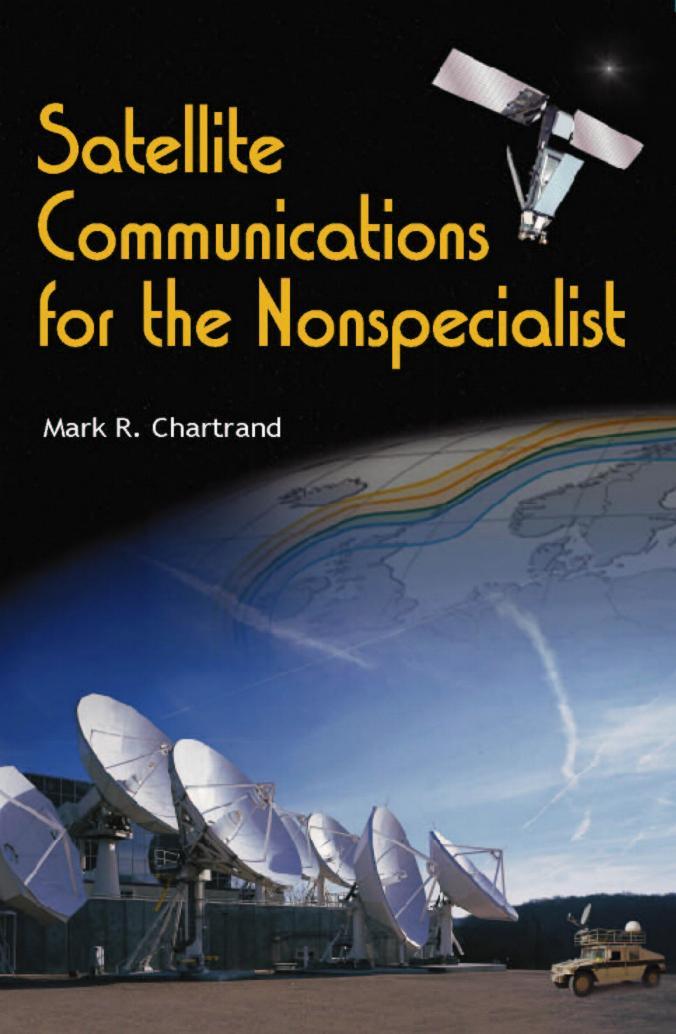
Now available, a full textbook based on this seminar.
This text is largely non-mathematical, with the math details more fully explained in the appendices, complete with full index, glossary of terms and acronyms, and more. For a complete table of contents and some sample pages, and to order, see http://www.spie.org/bookstore
Comments from previous attendees:
"Overall the best seminar on any subject I've ever attended. It is
absolutely vital for filling in gaps in knowledge of any satellite or
communications professional."--Chuck DeCaro, CEO, Aerobureau
"This is without a doubt the most interesting and informative course I
have ever attended, and it completely fulfilled my expectations. This is due in
no small measure to Dr. Chartrand's delivery and style of
lecturing."--Andrew Jordan, Asiasat
"I was terribly impressed with the amount of information that Dr.
Chartrand has."--John Reynolds, HBO
"Dr. Chartrand was very well prepared. He has an excellent knowledge of
satellite technology."--Andre Cortese, Comsat
"The seminar leader was extremely good at relating technical topics to easy examples as comparison."--Michele Susko, Total Communications Program
"Excellent management level satellite communications course. A 2-day
course with 2-weeks of material." --Eric N. Cardwell,
NEC America
In addition to presentation to mixed business groups in the United States, Canada, the Caribbean, Europe, and Asia, this seminar has also been presented as customized in-house training for many firms, including:
Satellite Communication-An Essential Introduction seminars are held under the auspices of Applied Technology Institute (ATI). For further information, and to register, contact ATI at:
Applied Technology Institute
349 Berkshire Drive
Riva, MD 21140
Telephone: +1 410-956-8805 or 888-501-2100
Facsimile: +1 410-956-5785
Email: aticourses@aol.com
Website: www.ATIcourses.com
The next several public sessions of this seminar will be presented on the following dates:
September 21-23, 2010 | Los Angeles, CA area
December 14-16, 2010 | Washington, DC area
March 8-10,
2011 | Washington, DC area
Special 1-day condensed version:
Communications Via Satellite--The Basics
at Satellite 2011:
March 14, 2010
Washington, DC
For information, see www.satellite2011.com
For more information on cost-saving and convenient customized in-house presentations of this seminar or seminars on related topics, or consulting services for the satellite communications field, please contact
Dr. Mark R. Chartrand
Telephone: +1-410-467-0763
Email: seminars@mrchartrand.com
Our principals and associates have performed a wide variety of consulting tasks in both technical and business areas for many firms. Please contact us for information at info@mrchartrand.com.
Our clients have included:
Copyright ©2008 by Mark R. Chartrand.